 Photo: Nobleseed Nobleseed
Smoke First, Sous-Vide Second: The Method Behind Our Consistency
Why BBQ Art Co. smokes brisket and ribs over real hardwood first, then finishes sous-vide to precise doneness - the method behind our consistency.
Barbecue Has Two Jobs. We Gave Each One Its Own Stage.
People find our food truck for a lot of reasons - the reviews, the awards, the smell of oak drifting across a brewery parking lot. But the question I get asked most, once someone has tried the brisket, is some version of: how is it this consistent from a truck? The honest answer is our method. At BBQ Art Co. we smoke over real hardwood first, then we finish sous-vide. That order is deliberate, it is unusual, and it is the foundation of everything we serve.
I was born in Lithuania, where cooking meat over fire is tradition, not trend. When I started cooking barbecue seriously here in Southwest Florida, I refused to accept the standard tradeoff: that great smoked meat has to be a gamble. Every barbecue cook is really doing two separate jobs. Job one is flavor and bark - real wood smoke, rendered fat, a crust with character. Job two is doneness - getting the inside of a tough, collagen-heavy cut to that exact point where it turns silky and tender without drying out. Traditional pits ask one fire to do both jobs at once. We split them, and we run them in the only order that works.
Stage One: Real Wood Smoke, Where Flavor Is Built
Everything starts at the fire. Seasoned, raw cuts go over genuine hardwood smoke - the same oak, pecan, and fruitwood approach I break down in our guide to smoking woods. This is not liquid smoke, not an oven with a smoke box. It is fire, wood, and time.
The order matters because of what raw meat does that cooked meat cannot. A cold, raw surface absorbs smoke compounds eagerly - the proteins are still open, the surface is drying and developing the foundation of bark, and the smoke ring is setting deep at the edge of the meat. A brisket spends five to six hours in that smoke before it goes anywhere near a water bath. By the time the smoke stage ends, the cut has taken on its color, its crust has structure, and the flavor that defines everything on our menu - the mahogany exterior you see on our pork belly burnt ends - is already built. If you want the deeper chemistry of what makes a great crust, our bark science post goes down that rabbit hole.
Stage Two: The Water Bath, Where Doneness Is Decided
After the fire has done its work, the smoked cut is vacuum-sealed and finished in a circulating water bath held at a precise temperature - not roughly, not "about right," but exact. For big barbecue cuts, that matters more than almost anything else, because the transformation that makes brisket sliceable and ribs bite-through-tender is collagen converting to gelatin, and that conversion is a function of temperature and time.
In the bath, three things happen that no offset smoker can promise on its own:
- Edge-to-edge doneness. The whole cut - center, corners, the thin end of a brisket flat - reaches the same internal temperature. There is no overcooked edge protecting an undercooked middle.
- No evaporative loss. In a pit, a big cut can sweat out moisture for hours during the stall. In the bag, those juices have nowhere to go. They stay with the meat, and we put them back on it at service.
- Time works for us, not against us. Held at the right temperature - a brisket rides at 155°F for 24 to 36 hours - collagen keeps converting gently for as long as the cut needs. Every brisket is different coming in; every one comes out at the same doneness.
When stage two ends, the inside of the meat is exactly where we want it, and nothing about a busy service day can undercook or overcook it.
Why This Order and Not the Reverse
Plenty of home cooks experiment with smoke and sous-vide in various sequences, and you can make good food more than one way. We land firmly on smoke-first for three reasons.
Smoke needs raw meat. If you sous-vide first and then smoke, you are trying to apply smoke flavor to fully cooked, sealed meat. The surface proteins have already denatured, so they will not absorb smoke compounds the same way, and bark will not form properly because the surface starts wet rather than raw. Smoke-first means the meat is maximally receptive during the only window that counts.
Precision should finish the job, not fight the fire. Doneness is the hard, unforgiving part - a few degrees separate sublime brisket from dry or rubbery brisket. Handing the finish to a device built for precision, after the fire has done the expressive work of flavor and bark, puts each tool where it is strongest.
A food truck cannot serve excuses. On a truck, there is no "the brisket needs two more hours" at an event with 150 hungry guests. Because the bath locks in doneness ahead of time, service day starts with perfectly cooked meat that needs only slicing and holding. That is a promise a traditional smoke-only overnight cook simply cannot make.
We wrote a full technical deep-dive on this sequence - temperatures, timing, and the one honest tradeoff - in Why We Smoke Then Sous Vide if you want to go further down the pit-nerd path.
One honest note for the purists, because I would rather earn your trust than dodge the question: the famous pink smoke ring is a color reaction, not a flavor, and ours is fully set during the smoke stage before the meat ever touches water - we wrote about that in reading the smoke ring. I cook for what you can taste: smoke depth, bark, tenderness, juice. On those measures, this method does not compromise. It outperforms.
The Proof: Consistency You Can Measure
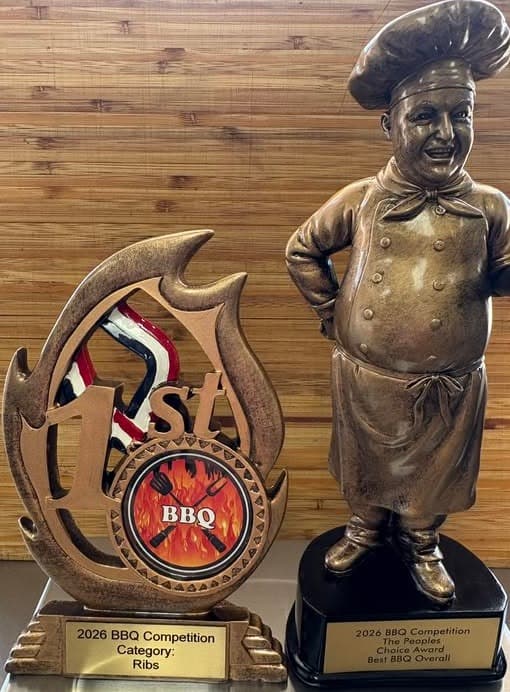
Methods are talk. Results are not. In June 2026 we entered the BBQ competition at Loaded Cannon Distillery in Bradenton and came home with Best BBQ Overall, People's Choice, 1st Place Ribs, and 1st Place Miscellaneous - three trophies, one method. Back home, our customers have left us 68 Google reviews holding a 5.0-star average. I am proud of the trophies, but the reviews mean more, because they are written by people who ate at the truck on an ordinary Tuesday and got the same brisket the judges did. That is the entire point of smoke-then-sous-vide: the peak is repeatable.
What Gets the Full Treatment
The method anchors our whole smoked lineup: brisket, baby back ribs, pulled pork, and pork belly burnt ends. Those meats then flow into everything else on the menu - sandwiches in 1/4 lb and 1/3 lb sizes, combo plates, BBQ sundaes layered with meat and sides, and mac bowls. Even the supporting cast gets the artisan treatment, like the Russian coleslaw that carries a little of my Lithuanian heritage in every batch.
Come Taste the Method
I can explain fire management and bark chemistry all day, but barbecue is an argument you settle with your mouth. Check the schedule to find the truck around North Port, Venice, Sarasota, Port Charlotte, Englewood, or Punta Gorda. Planning an event? Our smoke-then-sous-vide method is exactly why our catering tastes the same for the last guest in line as the first - request a free quote, or call me directly at (916) 804-1579. Bring your skepticism. I will bring the brisket.
Arthur Gumirov
Founder & Pitmaster · BBQ Art Co.
Known as “Art” at the truck, Arthur is the Lithuanian-born founder and pitmaster behind BBQ Art Co. He built the operation around a signature method — hardwood smoking finished sous vide — that earned Best BBQ Overall, People's Choice, 1st Place Ribs, and 1st Place Miscellaneous at the 2026 BBQ Competition. He personally oversees every cook and catering event across North Port, Venice, Sarasota, and the rest of Southwest Florida.
Meet the Pitmaster →Award-Winning BBQ, Catered to You
Hungry yet? Let’s feed your crew.
Weddings, corporate lunches, backyard parties — our smoked & sous-vide BBQ travels anywhere in Sarasota & Charlotte counties. Free quotes, fast replies.
Keep Reading

The Hardwoods We Use and Why: Oak, Pecan, Cherry, and Hickory
Wood selection is half the flavor equation in BBQ. Here's exactly which hardwoods BBQ Art Co. burns, why we choose them, and how each affects your plate.

Why We Smoke Then Sous Vide: The BBQ Art Co. Method Explained
Most pitmasters pick one. We use both — here's why smoking then sous vide produces brisket and pork that's juicier, more consistent, and more deeply flavored.

Bark Science: How to Build the Best Crust on Smoked Brisket
Bark is the most texturally complex part of great brisket — part crust, part caramel, all flavor. Here's the science and craft behind building it right every time.